Help
- Getting started
- Location: client, residents and floor plans
- Orientation: facing and sitting directions
- Finding the center
- Flying Stars and how to read a palace
- Viewing, printing and exporting
- Calculation conventions (FAQ)
Getting started
- Explore the example. Choose File > Open Example Document (also in the Help menu). It opens a fully worked example as an untitled copy, so you can change anything; Save asks where to keep your copy.
- Start your own. Choose File > New, then import a floor plan: an image or a PDF. Then set the building's orientation, and Twenty-Four Mountains draws the Ba Zhai and Flying Stars charts over the plan.
- Documents are saved as
.24mtnsfiles wherever you choose on your Mac. Nothing is uploaded anywhere.
Location: client, residents and floor plans
Choose Meta Map > Edit Location… (or the Location toolbar button).
- Name and address identify the client or site.
- Photo: Import Photo… adds a picture of the building.
- Floor plans: Import Floor Plan… adds one plan per floor or scenario. Duplicate copies the selected plan, including its orientation and center outline, so you can compare variations; − removes it. A document needs at least one floor plan.
- Residents: Add Resident, then enter each person's name, date of birth and gender. Each resident's Ming Gua (personal trigram) is calculated from these, and selecting a resident in the main window shows their favorable directions over the plan.
Orientation: facing and sitting directions
Choose Meta Map > Edit Orientation… (or the Orientation toolbar button).
- Select the floor plan to orient.
- Click and drag on the plan so the red arrow points in the building's facing direction. Hold Shift while dragging to snap to 45° steps.
- Fine-tune the Facing and Sitting degrees with the fields or arrows. When "Sitting is opposite facing" is checked, sitting stays exactly 180° from facing.
- Choose the Hemisphere of the location. Southern Hemisphere locations use the southern convention for the annual star.
Compass readings: degrees are used exactly as entered, which is the magnetic reading from your luo pan or compass. Twenty-Four Mountains does not correct for magnetic declination; if your practice works from true north, adjust the reading before entering it.
Finding the center
Choose Meta Map > Edit Centroid… (or the Centroid toolbar button) to find the center of an irregular building.
- Click a corner of the building to start the outline.
- Click each following corner in turn; each click adds a side. Approximate curves with several short sides.
- Click the orange starting point to close the shape. The center is then calculated and shown.
- Drag any point to adjust it, or click Reset to start over.
Flying Stars and how to read a palace
Choose Meta Map > Edit Flying Stars… (or the Flying Stars toolbar button).
- Construction Date is the year of construction or the last major renovation. It sets the period, the Lo Shu age star, of the chart.
- Annual Star Year sets the year for the annual stars. The Feng Shui year begins at Li Chun, around February 4. In version 2.0, Set to current year fills in this year.
- Month (version 2.1 and later) shows the monthly stars for one month of that year, listed with the dates it begins and ends. None hides them. The choice is saved with the document and shown on every chart.
- Always use today's date (version 2.1 and later) keeps the chart on today's Feng Shui year and month, and turns on the monthly stars. When you open the document in a later Feng Shui year, the year moves forward (so the document counts as changed). Untick it to keep the current year and month fixed, for example for a dated report. The example document has it ticked.
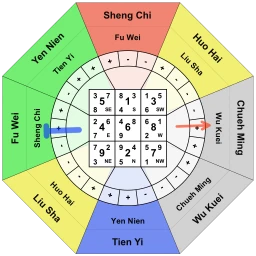
- The chart's Lo Shu Age, Mountain, Water and Annual center stars are listed beside it, along with the facing and sitting directions.
How to read a palace
Each of the nine palaces of the chart shows the same set of stars in the same places:
| Mountain star | Water star | |
| Age star | ||
| Monthly star | Annual star | Direction |
- Age star (large, center): the period star of the base Lo Shu chart for the construction period.
- Mountain star (top left): the sitting star, traditionally associated with people, health and relationships.
- Water star (top right): the facing star, traditionally associated with wealth and opportunity.
- Annual star (bottom center): the visiting star for the selected year.
- Monthly star (bottom left; version 2.1 and later): the visiting star for the selected month. It appears only when a month is chosen.
- Direction (bottom right): the compass sector of the palace, such as SE or N.
For what each star means in each palace, and suggested cures, open the Reference panel (View > Toggle Reference Panel).
Viewing, printing and exporting
- View menu: show or hide the floor plan, Ba Zhai, directions, Flying Star chart and 24 Mountains ring, and switch the chart between Circle and Grid styles.
- View Settings (toolbar) adjusts how the overlays are drawn.
- Print: File > Print prints the current map.
- Year ahead (version 2.1 and later): File > Print Year Ahead… prints one page for each floor plan with its 12 monthly Flying Star charts for the annual star year, each labelled with its month, animal and dates. Tick Include annual chart in the print dialog to add the year's chart and the palace key. To make a PDF for a client, choose File > Export Year Ahead as PDF… (the same option is in its save dialog), or Save as PDF in the print dialog. To print only some floor plans, choose their pages in the print dialog.
- Export: File > Export Map as saves the map as PDF, TIFF, BMP, JPEG, PNG or JPEG 2000.
Calculation conventions (FAQ)
Feng Shui schools differ on a few points of calculation. These are the conventions Twenty-Four Mountains follows, so you can match them to your own practice.
Which north does the app use?
Compass readings are used exactly as you enter them, which is the magnetic reading from a luo pan or compass. The app does not correct for magnetic declination. If your practice works from true north, adjust the reading before entering it.
When does the year begin for annual stars?
At Li Chun, the start of spring, when the Sun reaches 315° (around February 4). For example, the 2026 annual star applies from Li Chun 2026 until Li Chun 2027. Southern Hemisphere locations use the southern convention for the annual star, so the same year shows a different annual star: 1 in the north and 6 in the south for 2026.
When does the year begin for a resident's Ming Gua?
- Northern Hemisphere: at Chinese New Year (the lunar new year, between January 21 and February 20). Someone born before Chinese New Year uses the previous year's Ming Gua. Some schools use Li Chun (around February 4) instead, which only gives a different result for people born between those two dates. From version 2.1 you can choose either in Preferences > Ming Gua Year, and residents born between the two dates show a ✱ beside their Ming Gua.
- Southern Hemisphere: at Li Qiu, the southern counterpart of Li Chun, when the Sun reaches 135° (around August 7). This applies from version 2.1; version 2.0 used a mid-May cutoff by mistake, so check the Ming Gua of Southern Hemisphere residents born between mid-May and early August.
How are the monthly stars calculated? (version 2.1 and later)
- Feng Shui months begin at the solar terms, not on calendar dates: month 1 begins at Li Chun (around February 4), and each later month begins about 30 days later, around the 4th to 8th of each calendar month. Months 11 and 12 fall in December and January.
- Month 1's center star depends on the year's animal: 8 in Rat, Rabbit, Horse and Rooster years; 5 in Ox, Dragon, Goat and Dog years; 2 in Tiger, Snake, Monkey and Pig years. Each later month's center star is one lower, with 9 following 1.
- The same monthly chart is used in both hemispheres. Some schools shift Southern Hemisphere months by six months to follow the local seasons; an option for that is planned.
How are Chinese terms spelled?
In pinyin, the standard romanization, from version 2.1. Older books often use other spellings, so the Ba Zhai stars renamed in 2.1 are listed here with their former spellings:
- Enhancing: Fu Wei; Tian Yi (Tien Yi); Sheng Qi (Sheng Chi); Yan Nian (Yen Nien).
- Draining: Huo Hai; Jue Ming (Chueh Ming); Wu Gui (Wu Kuei); Liu Sha.
"Lo Shu" keeps its familiar spelling (Luo Shu in pinyin), as does "Feng Shui". The Traditional Chinese version of the app uses Chinese characters.
How accurate are the solar term dates?
Solar terms are calculated from the Sun's position, within about 10 minutes of the times published by the Hong Kong Observatory. Only a date within minutes of a term could be affected.
Still need help?
See Support, or email support@twentyfourmountains.com.